
Blue Heron InfoTech Resource
Why successful backup jobs do not prove that systems, databases, and files can be recovered when needed.
A completed backup job is not the same as a recoverable system
Backup software can report success even when important data was excluded, credentials expired, application files were captured inconsistently, retention settings were wrong, or the recovery process was never documented. The backup may contain files, but not everything required to rebuild a working service. Restore testing is the process that turns backup activity into evidence of recoverability.
This matters because the first full restore should not occur during a ransomware event, hardware failure, accidental deletion, or facility outage. At that point, the organization is already under pressure and every undocumented dependency increases downtime.
Different systems require different restore tests
A file server test may involve restoring selected folders and verifying names, permissions, dates, and file integrity. A database test should restore the database into an isolated environment and confirm that the application can read it. A virtual machine test may require booting a recovered copy on an isolated network. A cloud application may need export validation in addition to the provider’s built-in retention features.
Workstations, network-device configurations, identity systems, websites, email, and private-cloud platforms each have different dependencies. A single statement that backups are tested is not enough. The recovery plan should identify what is tested, how it is tested, and what result proves success.
Recovery objectives give the test a business target
The recovery point objective, or RPO, describes how much recent data loss the organization can tolerate. The recovery time objective, or RTO, describes how quickly a system should be restored to an acceptable level of service. These are business decisions that guide backup frequency, replication, staffing, spare hardware, and recovery procedures.
A restore can be technically successful but still fail the business requirement. Recovering a production database in three days is not adequate if operations need it within four hours. Conversely, an expensive near-zero downtime design may be unnecessary for an archive that can remain unavailable for several days.
Testing reveals dependencies that backup reports miss
Applications often depend on DNS records, certificates, encryption keys, service accounts, firewall rules, storage mounts, identity providers, external APIs, or a specific software version. These details may not be included in the primary backup. A restore exercise exposes missing information and creates a more complete recovery package.
Testing can also reveal that the only recovery instructions are stored on the failed server, that backup administrators cannot access credentials during an outage, or that replacement hardware is unavailable. These are process failures, not backup-software failures, and they are difficult to discover without practice.
Use isolated and controlled test environments
Restored systems should usually be tested away from production. Booting a copied domain controller, mail server, or application server on the live network can create conflicts or send unintended messages. An isolated virtual network, recovery lab, or restricted test host allows validation without affecting normal operations.
Sensitive data in test environments still requires protection. Limit access, apply retention rules, and remove temporary restored copies when testing is complete. The test procedure should also state who may authorize a production restore and how changes made after the backup will be handled.
Document results and corrective actions
For each test, record the backup set used, start and completion times, personnel involved, systems restored, validation steps, problems found, and corrective actions. Update the recovery documentation when procedures change. A repeated test should confirm that previous problems were actually resolved.
The frequency should reflect business impact and rate of change. Critical databases may require frequent automated checks and scheduled full exercises. Less critical systems may be tested quarterly or annually. Major migrations, application upgrades, network changes, and backup-platform changes should trigger additional testing.
Restore testing supports realistic continuity planning
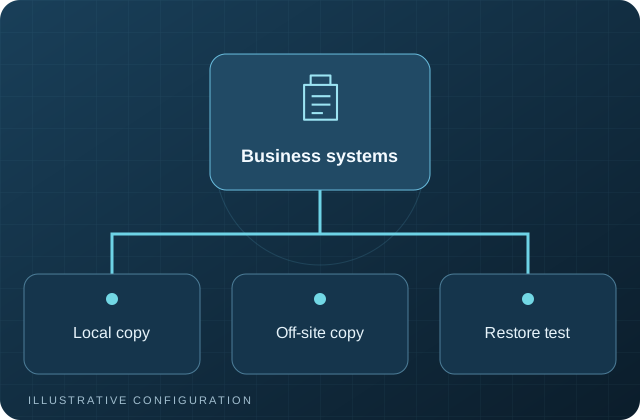
A dependable backup program combines protected copies, off-site or multi-location storage, monitoring, retention, recovery documentation, and tested procedures. Immutable or protected storage can reduce the risk that an attacker or administrator deletes every copy, but it still does not prove that the data can be restored correctly.
The useful question is not whether backup jobs are running. It is whether the organization can recover the required systems, within the required time, using procedures and resources that have been demonstrated. Restore testing provides that evidence without claiming that every possible failure can be eliminated.
Questions every recovery plan should answer
Can the organization reach backup systems if the primary identity platform is unavailable? Are encryption keys, licenses, certificates, and administrator credentials available through a protected emergency process? Is there enough network, storage, and computing capacity to perform a restore while normal operations are disrupted? These details often determine the actual recovery time.
The plan should also state who declares a disaster, who communicates with employees and customers, who contacts vendors, and who approves data rollback. Technical restoration and business coordination must proceed together. A server that is online but not validated by the application owner may not yet be ready for production use.
Discuss Your Infrastructure
Blue Heron InfoTech helps manufacturers and growing organizations assess private cloud, identity, training, backup, server, network, and managed IT requirements. An initial consultation can clarify the current environment and the next practical step.