
Blue Heron InfoTech Resource
A controlled account lifecycle reduces overlooked access when employees, contractors, or vendors leave.
How a documented central account lifecycle reduces overlooked access when an employee leaves or changes roles.
Offboarding is an access-control process
When an employee leaves, the organization must remove access to systems, data, facilities, devices, and third-party services. In a fragmented environment, that may require separate changes to email, file sharing, training, remote access, business applications, VPN accounts, websites, shared passwords, and vendor portals. Missing one account can leave unnecessary access active for months.
Centralized identity does not remove every offboarding task, but it creates a primary control point. A central directory can disable the employee’s main identity, remove group membership, block connected applications, and preserve a record of the action. This makes the process faster, more repeatable, and easier to verify.
When an employee leaves, the organization needs to remove access quickly and consistently while preserving records, transferring business information, and avoiding unnecessary disruption. The challenge is rarely one password. It is the number of systems the person could access: email, file storage, training, VPN, virtual desktop, business applications, shared credentials, and physical devices.
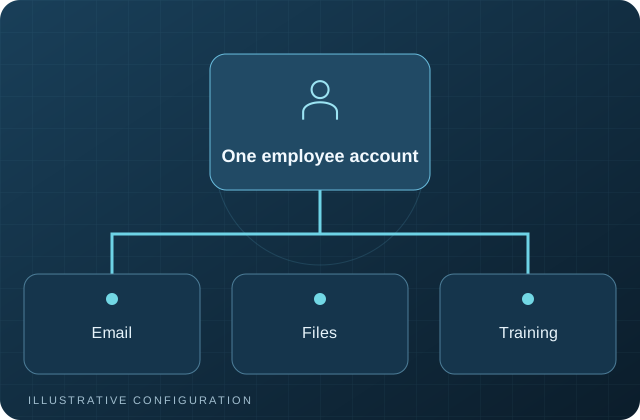
Centralized identity reduces this complexity by making one directory or identity provider the primary source for employee authentication. Disabling the central account can block access to many connected systems immediately. This does not finish every offboarding task, but it creates a reliable first control.
The directory must reflect the real account inventory
Centralization works only for applications that actually use or trust the identity platform. Some systems may use LDAP directly, while others use an identity provider through OpenID Connect or SAML. Legacy applications may still have local accounts. Cloud services may require separate deactivation or license removal.
Maintain an application inventory that identifies the owner, authentication method, administrative contact, and offboarding action for each system. This reveals gaps where local accounts, shared credentials, or personal email addresses are being used.
Groups make access easier to understand
Instead of assigning permissions individually, users can be placed into groups based on department, role, location, or responsibility. Applications and file systems then grant access to the group. During a role change, administrators adjust group membership rather than searching through each system for individual permissions.
Groups need governance. Names should be clear, owners should approve membership, and high-risk groups should be reviewed regularly. Too many overlapping groups can become as difficult to manage as individual permissions. The objective is understandable access, not simply more directory objects.
A disable action should have predictable effects
Before relying on central deactivation, test what happens in every connected application. Some systems end active sessions immediately; others allow the session to continue until a token expires. Some retain local fallback passwords. Mobile devices may retain synchronized data even after the account is disabled. Remote-access certificates or API keys may require separate revocation.
The offboarding checklist should distinguish immediate actions from follow-up actions. Immediate controls may include disabling the identity, revoking remote access, collecting devices, changing shared credentials, and preserving business records. Later tasks may include mailbox delegation, file ownership transfer, license removal, and data-retention decisions.
Coordination matters as much as technology
Human resources, the employee’s manager, IT, security, and facilities may each own part of the process. The timing can be sensitive, especially for involuntary separations. A documented workflow should identify who authorizes access removal, when IT is notified, and what evidence is retained.
Advance notice should be limited to those who need it, but late notice creates avoidable risk. For planned departures, ownership of files, email, customer relationships, and active projects should be addressed before the final day.
Preserve records without preserving access
Disabling an account should not automatically delete business data. Email, files, training records, audit logs, and application history may need to be retained according to company policy, contractual requirements, or legal advice. Ownership can be transferred while interactive access remains blocked.
Deletion and retention rules should be defined before an incident. Unlimited retention creates cost and privacy concerns, while immediate deletion may remove evidence or business records. The identity record can be disabled and retained for audit purposes without allowing sign-in.
Review the process regularly
Periodic access reviews can identify departed users who remain active, service accounts tied to former employees, dormant contractor accounts, and applications outside the central directory. Review results should lead to corrective actions and improvements to onboarding and application integration.
Centralized identity simplifies offboarding because it provides one governed starting point and consistent account data. It is most effective when combined with an application inventory, group-based access, tested session controls, device procedures, and clear coordination among business functions.
Questions for an offboarding checklist
Who has authority to request deactivation, and how is that request verified? Which systems terminate sessions immediately, which require manual action, and which contain data that must be transferred? Include physical badges, mobile devices, VPN certificates, shared passwords, API tokens, and vendor accounts in addition to the central directory.
After the departure, require a documented review by the manager or system owner. Confirm that access was removed, records were preserved appropriately, licenses were reclaimed, and outstanding ownership transfers were completed. This final check closes the gap between initiating offboarding and proving that it was completed.
Why scattered accounts create risk
Without a central process, accounts are often created independently by different departments or vendors. Some use a work email address, some use a personal address, and some are shared by several employees. When a person leaves, no one has a complete inventory. Access can remain active simply because the account was forgotten.
Spreadsheets and checklists help, but they depend on accurate maintenance. Central identity provides technical enforcement for connected systems and can produce clearer logs of account status and authentication activity.
Disable first, then complete the workflow
The first step should usually be disabling sign-in, active sessions, remote access, and privileged credentials at the agreed separation time. The exact timing should be coordinated with management and HR. The account may be retained in a disabled state while email, files, and records are transferred according to policy.
Deletion should not be the automatic first action. Immediate deletion can remove information needed for operations, legal retention, payroll, quality records, or customer communication. The organization should define retention and transfer procedures in advance.
Use groups and roles to make access understandable
Central identity is most useful when access is assigned through documented groups rather than individual exceptions. A user might belong to Engineering, Quality, Supervisors, or Remote Access groups. When the user is removed or disabled, the connected permissions become easier to understand and review.
Role changes should use the same process. An employee moving departments may no longer need access to old files, applications, or administrative functions. Offboarding is one part of a broader account lifecycle that includes onboarding, transfers, leaves of absence, and contractor expiration.
Systems that still need separate action
Not every application supports central authentication or automated provisioning. Some accounts may need to be disabled manually. Shared mailboxes, vendor portals, social-media accounts, banking access, domain registrars, equipment controllers, and locally managed applications may remain outside the identity platform.
The offboarding checklist should separate centrally controlled systems from manual systems. It should also cover company devices, mobile access, keys, badges, tokens, application passwords, API keys, and any shared credentials the employee knew. Shared credentials should be minimized and changed when exposure is possible.
Preserve evidence and business continuity
Logging can help confirm when the central account was disabled and whether sign-in attempts continued. Mailbox delegation, file ownership transfer, and manager access should be documented and limited to legitimate business needs. Privacy and employment requirements vary, so the process should be reviewed by appropriate legal and HR advisers.
Before a departure, identify active projects, automated jobs, service accounts, and scheduled tasks associated with the employee. A personal administrator account should not run a critical business service. Move those functions to controlled service accounts with documented ownership.
Test the process before it is urgent
Create a standard checklist with responsible roles, timing, required approvals, and validation steps. Run a tabletop exercise using a fictional employee. Confirm which systems are disabled automatically, which require manual work, and who can perform the actions if the primary administrator is unavailable.
Central identity does not remove the need for a checklist. It makes the checklist shorter, faster, and more enforceable. The desired result is a process the organization can execute consistently and verify afterward.
Create evidence that the process was completed
The completed checklist should identify the separation time, approving manager, administrator, systems disabled, devices returned, information transferred, and exceptions that remain open. Store the record according to the organization’s HR, security, and retention policies. Do not include passwords in the checklist.
Periodically compare active employee records with directory accounts, VPN users, administrators, email accounts, and major applications. This access review can identify missed departures, duplicate identities, temporary accounts that never expired, and privileges that no longer match a person’s role.
Questions for HR, management, and IT
Agree on who authorizes the disablement, the exact effective time, which records must be retained, and who receives access to business files or email. Define how urgent or involuntary departures differ from planned departures.
Confirm how contractors, vendors, seasonal workers, and shared accounts are reviewed. These identities often fall outside the normal employee process and can remain active long after the original need has ended.
Discuss Your Infrastructure
Blue Heron InfoTech helps manufacturers and growing organizations assess private cloud, identity, training, backup, server, network, and managed IT requirements. An initial consultation can clarify the current environment and the next practical step.